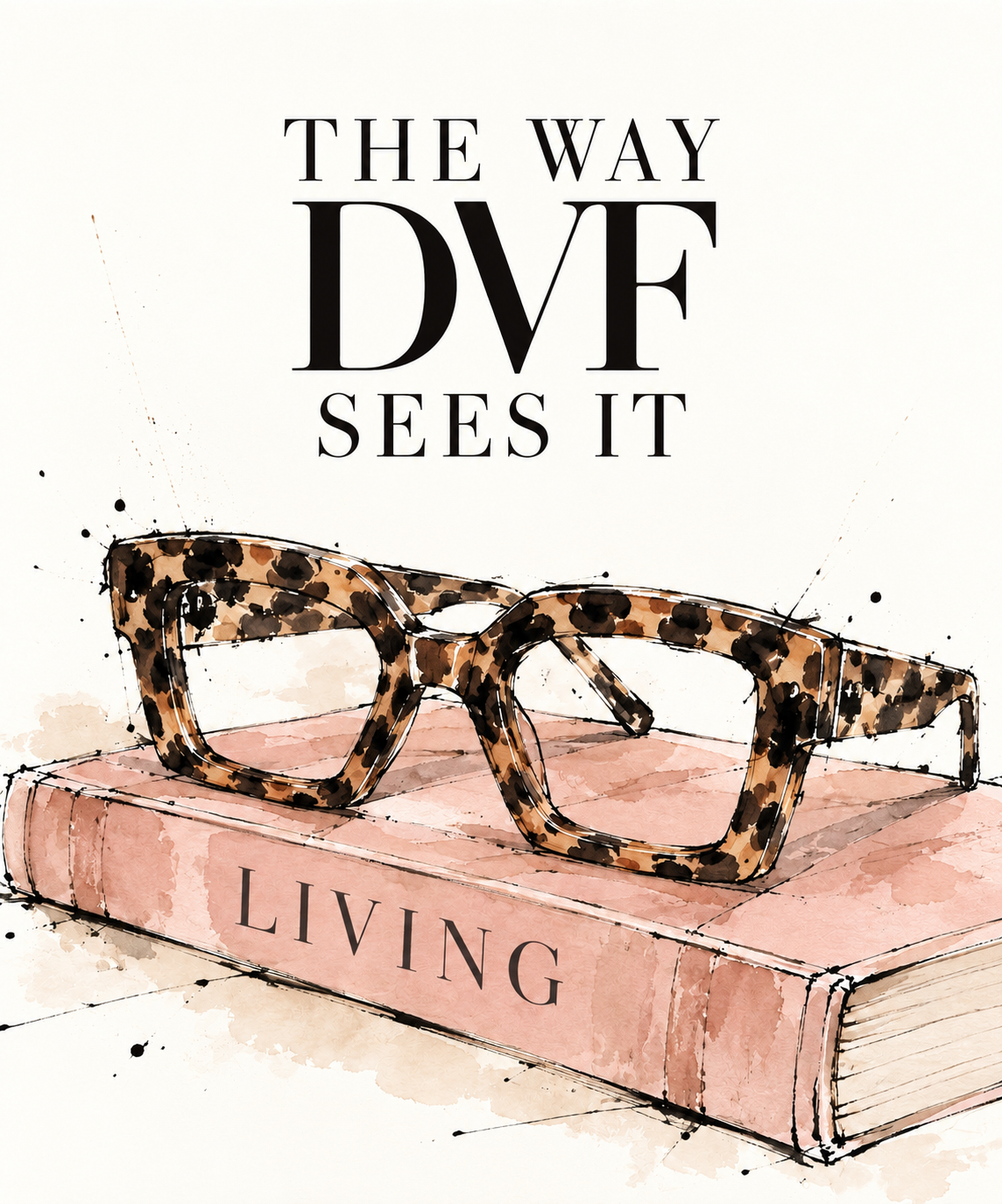
THE WAY DVF SEES IT.
On living, beauty, and the lens we choose.
I could have listened to Diane von Furstenberg talk for hours. In fact, I nearly did.
I first heard her on Aspire, in conversation with Emma Grede, and by the time it ended, I wanted more. So I went looking and found her conversation with Julia Louis-Dreyfus on Wiser Than Me. Listening to Diane is a little like drinking a fine wine, if I drank. There is something about a woman who has lived that much life and has no interest in pretending otherwise.
What stayed with me most was the way she talked about aging. Or rather, the way she refused to talk about it as aging at all.
“The word aging… I would change the word aging and say living.”
It is such a small shift in language, and yet it changes the entire premise. Diane talks about age as evidence; she suggests asking someone how long they have lived instead of how old they are. It’s as though she has tapped into an inner trust in the years themselves, that they aren’t something happening to her, but rather proof that she has been here for them.
I have always felt grateful to grow older, so perhaps I was particularly receptive to this. There are years of my life I would happily revisit for an afternoon, people I would give almost anything to sit beside again, versions of myself I remember with enormous affection. I still wouldn’t give up the woman I am now to become any of them again. I like knowing what I know now, and I like the history that lives behind my own face.
Diane also talks about liking what she calls a slightly “destroyed look” because “it’s lived.” I knew exactly what she meant. There is beauty in a face that has participated in its own life.
What I appreciated even more was that she didn’t make a virtue out of it. When the conversation turned to plastic surgery, Diane was clear that she doesn’t judge what anyone else chooses to do. There was no lecture about accepting yourself exactly as nature intended, no moral superiority attached to wrinkles. She likes a little evidence of living on herself and leaves another woman free to prefer something else entirely.
That may be what makes her perspective so appealing. DVF has spent most of her adult life in the business of beauty, surrounded by clothes and photographs and women whose appearances are examined for a living. She hasn’t emerged from all of that insisting beauty doesn’t matter. She clearly still loves beauty, but has simply lived long enough to know that perfection and beauty were never the same thing.
Later, when Julia Louis-Dreyfus uses the familiar phrase “aging gracefully,” Diane changes that too.
“Just call it living gracefully.”
I think that is what I kept hearing across both conversations. Diane doesn’t seem interested in fighting with the fact that life leaves evidence. She has been young and beautiful, successful and famous. She has loved people, lost people, built things, and become a woman who can look back on decades of her own life. She speaks about all of it with the confidence of someone who isn’t trying to negotiate for more youth in exchange for everything those years gave her.
Maybe that is why I kept listening.
There is something deeply beautiful about hearing a woman speak from inside her own life without apologizing for any of it.
And it made me think about how much power we give to the language around getting older. We say someone still looks good, as though beauty has an expiration date that she has somehow managed to negotiate an extension on. We compliment women for looking younger than they are. We call certain changes signs of aging, which is technically true, although they are also signs of living and being blessed to have lived these many years.
None of this means we have to adore every change that comes with getting older. I certainly don’t think Diane is asking us to. Wanting to color our hair, smooth something, lift something, change something, or leave everything exactly where life put it can all exist alongside gratitude for having made it this far. Maybe the more interesting question is why youth became the measure against which every later version of a woman is compared.
A photograph from twenty years ago can be beautiful without making the face we have now something that needs to be altered, as though it isn’t beautiful just as it is.
There was another idea Diane mentioned in both conversations that stayed with me. When life becomes difficult, she tries to change the lens. She told Julia about a friend facing painful medical tests whom she encouraged to move through the experience as though she were watching a documentary. With Emma, she described the same idea: detach from the moment enough to watch what is happening rather than becoming completely consumed by the emotion of it.
I love this idea, and I am also not always so great at it. There are experiences that are much easier to understand once I have some distance from them. Maybe changing the lens is a way of finding a little of that distance while we’re still in the middle of it. I’ll probably remember the analogy every time I reach for a pair of sunglasses now. Each pair has a different lens, and I certainly like the view through some better than others.
WRITTEN. LIVED. COLLECTED.
-Naturalist Way
SOURCES & FURTHER LISTENING
Aspire with Emma Grede
“Diane von Furstenberg: How to Become the Woman You Want to Be”
September 24, 2026 · 56 min
Diane von Furstenberg in conversation with Emma Grede about self-belief, independence, motherhood, aging, and the experiences that shaped her life and career.
Wiser Than Me with Julia Louis-Dreyfus
“Julia Gets Wise with Diane von Furstenberg”
Season 1, Episode 6 · May 9, 2023 · 48 min · Lemonada Media
Diane von Furstenberg in conversation with Julia Louis-Dreyfus about getting older, fashion, fearlessness, and the life she has lived.
IMAGE CREDITS
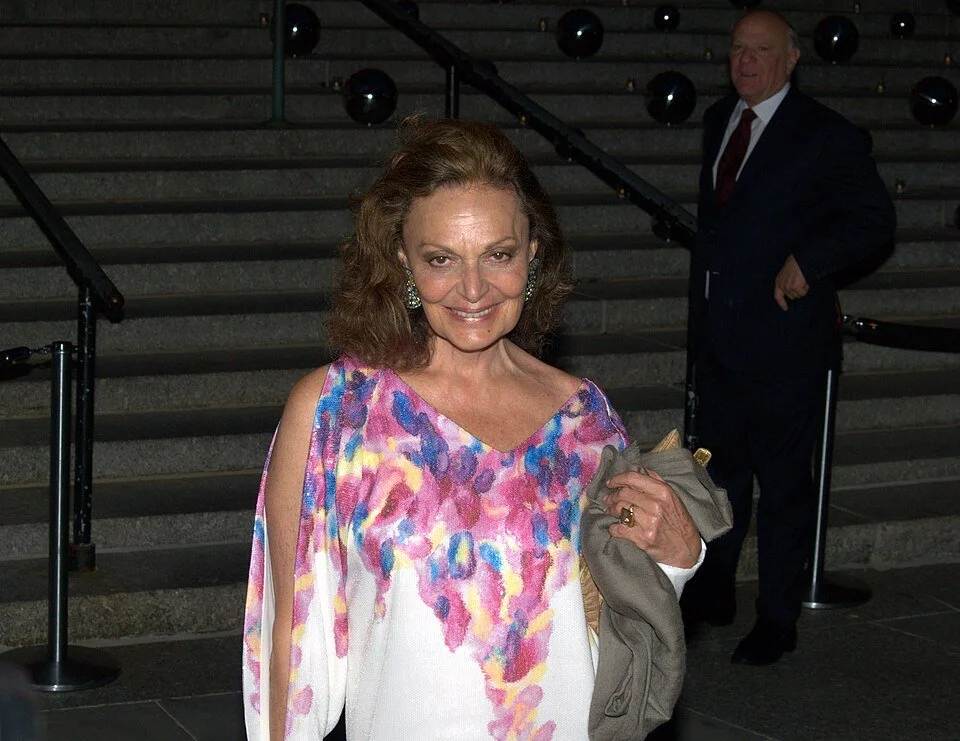
Diane von Furstenberg at the Tribeca Film Festival, 2010
Photograph by David Shankbone. Licensed under Creative Commons Attribution 3.0.
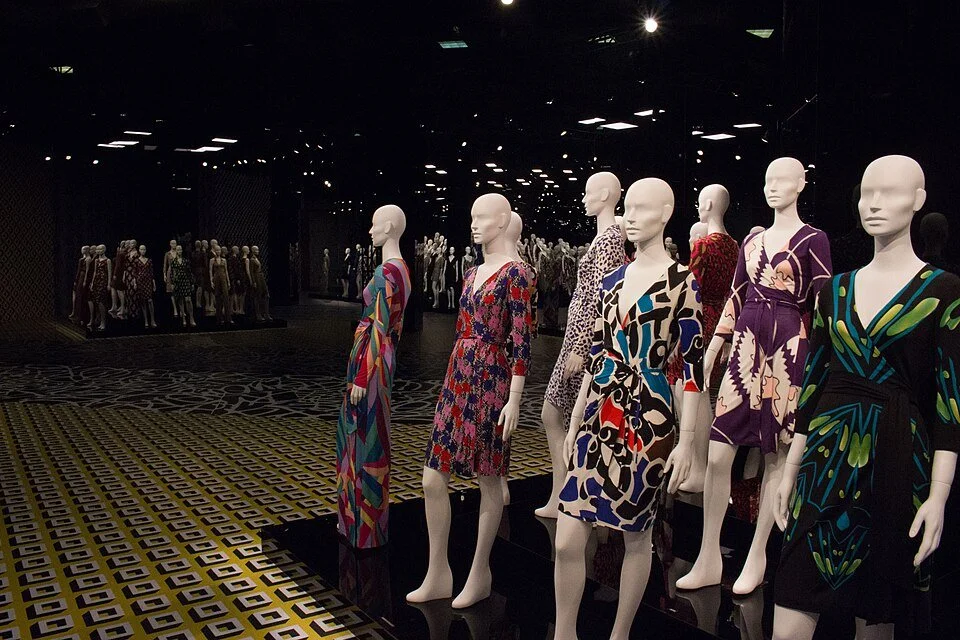
DVF: Journey of a Dress, LACMA, 2014
Photograph by Bruce Monroe. Licensed under Creative Commons Attribution-ShareAlike 2.0.